Baby Temperature Guide: What Is Normal and When to Worry
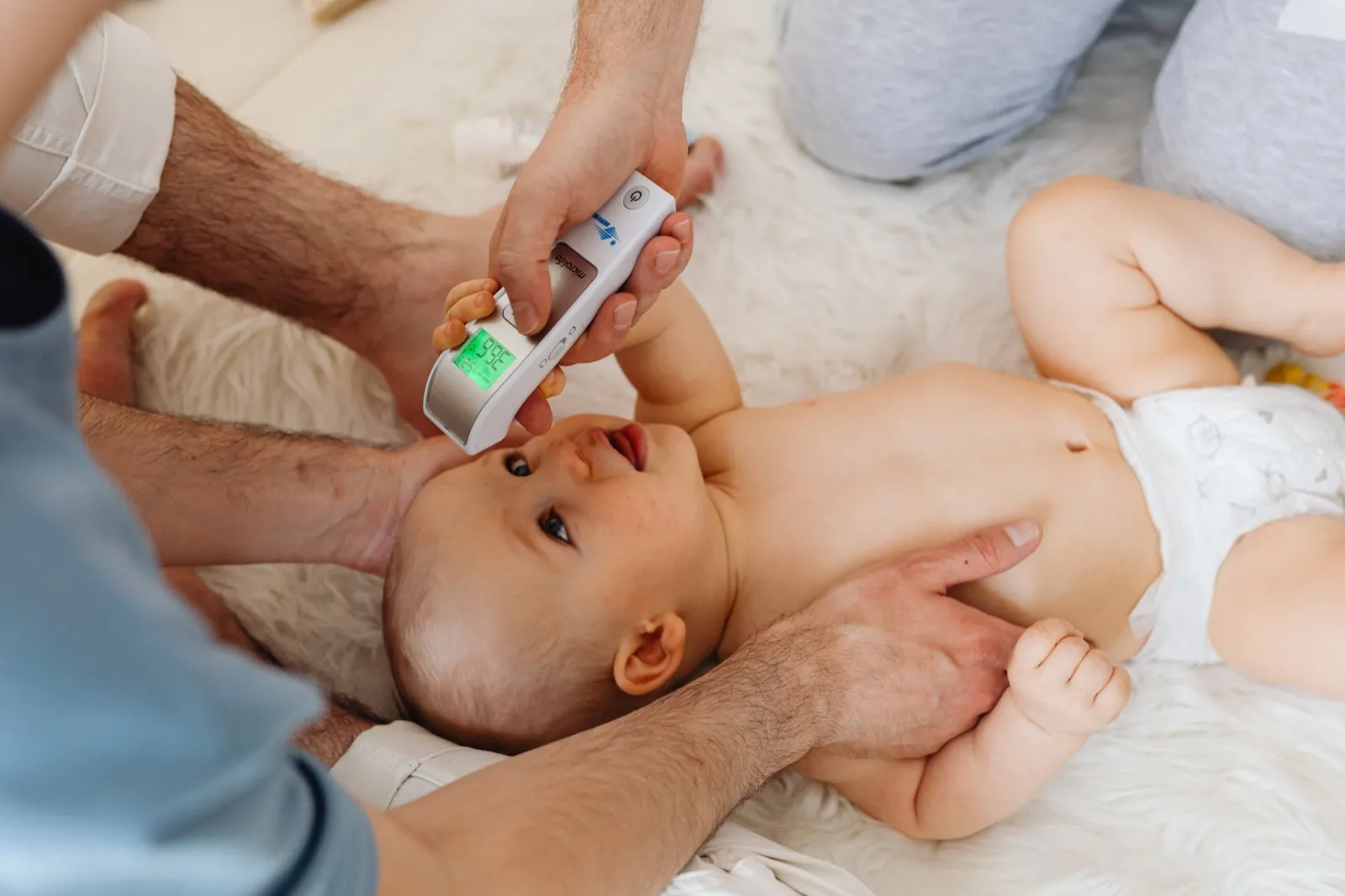
Image Credit: Pexels / https://kaboompics.com/
If your baby suddenly feels warmer than usual, it is very easy to worry. A normal temperature in babies and children is around 36.4°C, although it can vary slightly. The NHS defines a high temperature, or fever, as 38°C or above.
Your baby’s age matters. A temperature of 38°C or higher in a baby under 3 months needs urgent medical advice. For babies aged 3 to 6 months, the NHS advises urgent medical advice for a temperature of 39°C or higher.
The number on the thermometer is useful, but it is not the only thing that matters. How your baby is breathing, feeding, waking and responding to you can also tell you a lot about how unwell they may be.
What is a normal temperature for a baby?
According to the NHS, a normal temperature in babies and children is about 36.4°C, but slight variation is normal.
A temperature of 38°C or above is considered a fever.
Body temperature naturally changes a little, so there is no need to become concerned because one reading is slightly different from another.
What matters is whether your baby has a genuine fever, their age and whether they have other signs of illness.
If your baby feels hot, sweaty or clammy, or their cheeks look flushed, check their temperature with a thermometer rather than relying on touch alone.
What temperature is considered a fever in babies?
The NHS defines a high temperature as 38°C or above.
However, the threshold for seeking medical advice depends partly on your baby’s age.
Babies under 3 months
If your baby is under 3 months old and has a temperature of 38°C or higher, ask for an urgent GP appointment or call NHS 111.
Fever in a very young baby needs prompt medical assessment because young babies can become seriously unwell more quickly and may not show the same obvious symptoms as older children.
Babies aged 3 to 6 months
If your baby is between 3 and 6 months old and has a temperature of 39°C or higher, the NHS advises asking for an urgent GP appointment or calling NHS 111.
You should also seek advice sooner if your baby seems unwell, even if their temperature has not reached 39°C.
Babies older than 6 months
For older babies, the temperature reading still matters, but their overall condition becomes particularly important.
A fever can accompany many common childhood infections. Seek medical advice if you are concerned, if the fever lasts for 5 days or more, or if your baby has other warning signs.
How to take your baby’s temperature accurately
For children under 5, the NHS recommends using a digital thermometer in the armpit.
To take the temperature:
- Sit your baby comfortably on your knee.
- Place the thermometer in their armpit.
- Hold their arm gently but firmly against their body.
- Leave the thermometer in place for as long as the manufacturer’s instructions recommend.
- Read the temperature shown on the display.
Many digital thermometers beep when the reading is ready.
Using the thermometer according to its instructions is more reliable than trying to judge a fever by touching your baby’s forehead.
Can a temperature reading be temporarily higher?
Yes. Some everyday situations can temporarily affect a baby’s temperature reading.
The NHS notes that a reading can be altered if your baby has recently:
- been wrapped tightly in a blanket
- been in a very warm room
- worn lots of clothing
- been very active
- had a bath
- been cuddling a hot water bottle
If one of these applies, allow your baby to cool down for a few minutes without letting them become cold or shivery, then take the temperature again.
Do not use this as a reason to delay seeking help if your baby looks seriously unwell.
Are ear thermometers accurate for babies?
Digital ear thermometers can provide quick readings, but the NHS notes that they may give misleading results if they are not positioned correctly.
This can be particularly difficult with babies because their ear canals are very small.
For babies and children under 5, the NHS recommends taking the temperature in the armpit with a digital thermometer.
Forehead strip thermometers are also not considered an accurate way to measure body temperature because they measure the temperature of the skin.
Avoid old-fashioned glass mercury thermometers. They can break and release mercury, which is poisonous.
What does a fever mean?
A fever is usually a sign that the body is responding to an infection.
It does not tell you by itself what infection your baby has or how serious it is.
Some babies and young children can also develop a high temperature after vaccination. If you are concerned about your baby’s temperature after vaccinations, follow the advice given at the vaccination appointment or contact a healthcare professional.
Do not try to diagnose the cause of a fever based only on the temperature reading.
Your baby’s age, behaviour and other symptoms all matter.
Look at your baby, not only the thermometer
A thermometer gives you useful information, but a relatively modest temperature does not guarantee that a baby is well.
The NHS advises parents to trust their instincts if they think their baby is seriously ill.
Pay attention to whether your baby:
- wakes and responds normally
- is feeding normally
- is breathing comfortably
- has their usual number of wet nappies
- can be comforted
- looks their usual colour
A baby who is unusually sleepy, difficult to wake, struggling to breathe or feeding significantly less than normal needs medical attention regardless of whether their temperature seems particularly high.
What about a low temperature?
A very low temperature can also be concerning, particularly when a baby appears unwell.
Current NHS meningitis guidance lists a temperature below 36°C, feeling cold to the touch or shivering among possible warning signs of serious illness.
A low reading does not automatically mean your baby has meningitis or another serious condition. Temperature readings can be affected by the environment and measurement technique.
However, if your baby has a temperature below 36°C and seems unwell, floppy, unusually sleepy, difficult to wake or is not feeding normally, seek urgent medical help.
What should you do if your baby has a fever?
If your baby has a high temperature but does not have emergency warning signs, keep them comfortable and monitor them closely.
The NHS recommends offering plenty of fluids. If you are breastfeeding, continue to offer breastfeeds.
Check on your baby regularly, including during the night.
Avoid wrapping a feverish baby in too many clothes or blankets.
Do not try to make your baby cold. The aim is comfort, not forcing their temperature down to a particular number.
If you are uncertain what to do, contact your GP, pharmacist or NHS 111 depending on your baby’s age and symptoms.
Should you sponge a baby with cold water?
Do not use cold water or deliberately make your baby cold in an attempt to reduce a fever.
NHS fever guidance advises against undressing a child or sponging them down specifically to cool a fever.
Dress your baby normally and avoid covering them in too many clothes or bedclothes.
If your baby is uncomfortable, speak to a pharmacist, GP or NHS 111 about appropriate treatment for their age rather than relying on cooling techniques.
What about fever medicine?
Paracetamol or ibuprofen may sometimes be recommended for children who are distressed or uncomfortable with a fever, but these medicines have age, weight and medical restrictions.
Do not give medicine simply because the thermometer shows a particular number.
Follow the product instructions and current NHS guidance, and ask a pharmacist, GP or NHS 111 if you are uncertain whether a medicine is suitable for your baby.
Do not give aspirin to anyone under 16 unless it has been specifically prescribed by a doctor.
For very young babies, seek medical advice rather than attempting to manage a fever yourself.
Signs that need urgent medical advice
Contact NHS 111 or ask for an urgent GP appointment if:
- your baby is under 3 months and has a temperature of 38°C or higher
- your baby is 3 to 6 months and has a temperature of 39°C or higher
- the fever has lasted for 5 days or more
- your baby is not their usual self and you are worried
- your baby is not feeding normally
- nappies are much drier than usual
- your baby has signs of dehydration
- your baby has a rash alongside a high temperature
Do not wait for a temperature to reach a particular threshold if your baby appears seriously unwell.
When a temperature may be an emergency
Some symptoms alongside an abnormal temperature require emergency assessment.
Call 999 or go to A&E if your baby has a high temperature and a rash that does not fade when pressed firmly with a glass.
Seek emergency medical help if your baby:
- is struggling to breathe
- will not wake up or is extremely difficult to wake
- has blue, grey, unusually pale or blotchy skin, lips or tongue
- has a first seizure or fit
- is unresponsive or unusually floppy
- has symptoms that make you think something is seriously wrong
Do not wait for every possible symptom to appear before getting help.
A simple baby temperature reference
For quick reference:
| Temperature or situation | What NHS guidance recommends |
|---|---|
| Around 36.4°C | About normal for babies and children, although normal temperature varies slightly |
| 38°C or above | Considered a high temperature or fever |
| Under 3 months with 38°C or above | Urgent GP appointment or NHS 111 |
| 3 to 6 months with 39°C or above | Urgent GP appointment or NHS 111 |
| Below 36°C with concerning symptoms | Seek urgent medical assessment |
| Fever with serious warning signs | Emergency medical help may be needed |
This table is a quick reference, not a substitute for assessing how your baby looks and behaves.
If you are worried, seek advice even if the thermometer reading falls outside these examples.
When to get professional advice
Ask for an urgent GP appointment or call NHS 111 if your baby is under 3 months with a temperature of 38°C or higher, or aged 3 to 6 months with a temperature of 39°C or higher.
Seek medical advice if your baby’s fever lasts for 5 days or more, if they are feeding poorly, showing signs of dehydration, unusually sleepy, increasingly unwell or simply not behaving as they normally do.
Call 999 or go to A&E if your baby is struggling to breathe, will not wake, has a first seizure, has a non-fading rash alongside fever, or has blue, grey, unusually pale or blotchy skin, lips or tongue.
A temperature reading is one piece of information. If your instincts tell you that your baby is seriously unwell, seek medical help even if their temperature does not seem particularly high.
Related reading
- Signs Your Baby Is Unwell: When to Seek Medical Help
- Baby Fever: What Parents Need to Know
- Baby Health & Safety Checklist: Essential Rules Every Parent Should Know