How to Support Your Baby’s Development Through Play
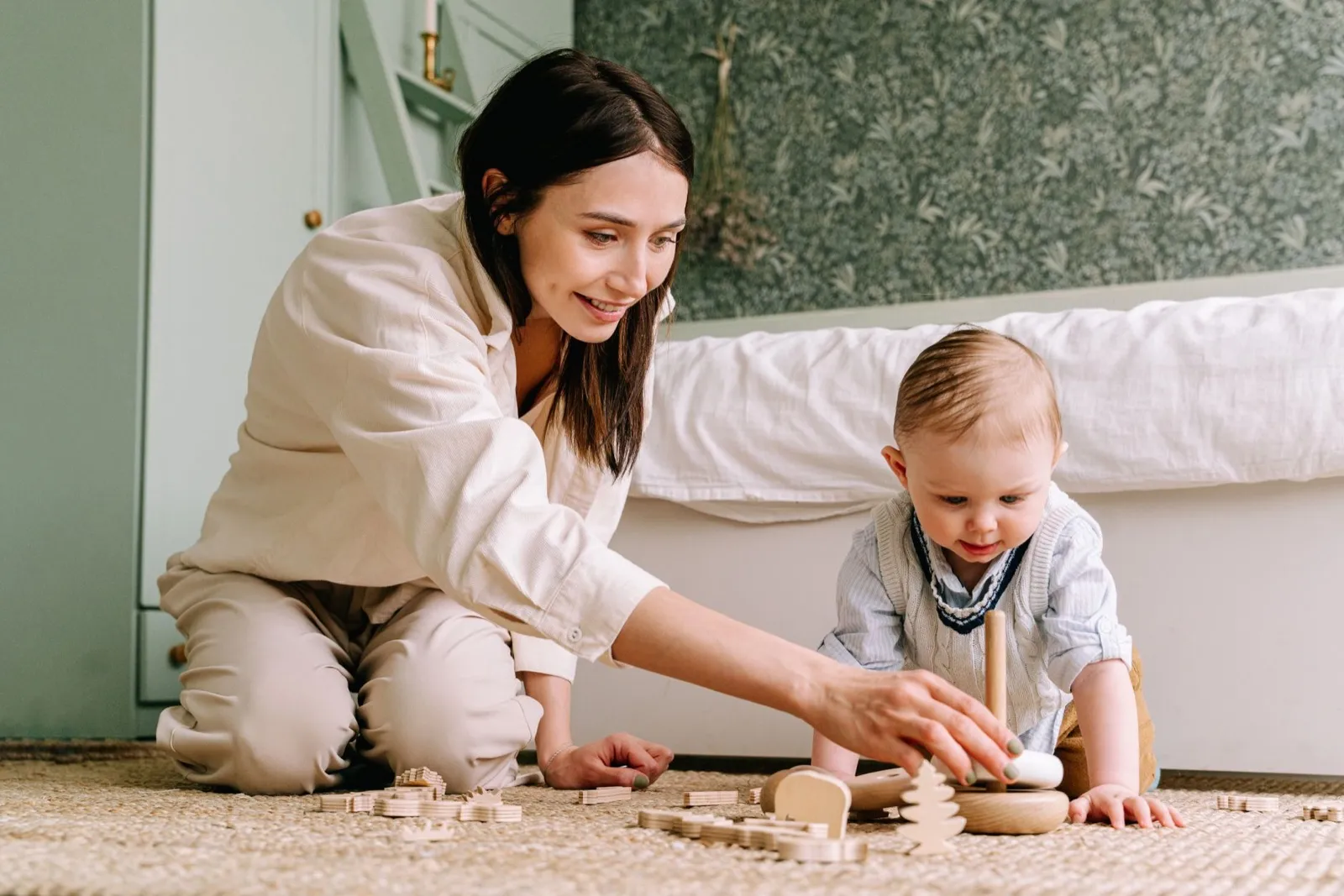
Image Credit: Pexels / Ivan S
Play is one of the simplest ways to support your baby’s development. In the first year, everyday activities such as talking, singing, tummy time, reaching for toys, looking at books and playing peekaboo can give babies opportunities to practise movement, communication, attention and social interaction.
You do not need expensive developmental toys, complicated activities or a carefully planned daily schedule. Babies learn through ordinary interaction and repeated opportunities to explore safely.
The best play usually follows your baby’s stage and interest. Some days they may be fascinated by a toy or game. On others, they may prefer watching your face, cuddling or quietly exploring something familiar. All of that can have a place in everyday life.
Why is play important for baby development?
Play gives babies opportunities to explore their bodies, other people and the world around them.
NHS guidance explains that play supports babies and young children as they learn to move, communicate, socialise and understand their surroundings. Everyday interaction can support several areas of development at once.
For example, reaching for a toy involves movement and hand-eye coordination. Talking about the toy adds language. Taking turns passing it between you introduces social interaction.
You do not need to separate development into different lessons.
A few minutes spent singing, chatting or playing on the floor may involve physical, cognitive, social and communication skills together.
Follow your baby rather than the activity
A useful starting point is to notice what has caught your baby’s attention.
If they are looking at your face, talk or make expressions. If they are reaching towards a toy, give them time to explore it. If they keep dropping something, they may be interested in what happens when they let go.
NHS Best Start in Life guidance encourages parents to notice what their baby is interested in and respond to their cues.
This can make play easier for parents too. You do not have to continually invent something new.
Sometimes your baby will turn away, become restless or lose interest. That is a reasonable cue to stop or change what you are doing.
Play does not need to last a particular amount of time to be worthwhile.
Play ideas for newborns
A newborn does not need much entertainment.
During the earliest weeks, your face, voice and touch provide plenty of stimulation.
The NHS recommends talking, singing and interacting with babies from birth. Babies are interested in faces and gradually begin responding to familiar voices and expressions.
Simple newborn play can include:
- holding your baby close and talking to them
- singing quietly
- making gentle facial expressions
- letting them look at your face
- giving them supervised tummy time while awake
- responding to the sounds and movements they make
Your newborn may only stay alert and interested for a short period.
There is no need to keep trying if they become tired or unsettled. Feeding, sleeping and being comforted take up much of newborn life.
Tummy time and physical development
Tummy time is a simple form of play that supports physical development.
The NHS says tummy time helps babies strengthen muscles they need for sitting and crawling. It should take place while your baby is awake and supervised.
You can place a toy or your face within your baby’s view to make the position more interesting.
If your baby does not enjoy being on the floor, NHS guidance suggests trying tummy time on your chest or across your lap.
Short attempts are fine. Some babies need time to become comfortable in the position.
As your baby grows stronger, tummy time may involve lifting the head, pushing through the arms, turning, reaching and eventually experimenting with movement.
Play ideas around 2 to 4 months
As babies become more alert, play often becomes more interactive.
By 2 months, the US Centers for Disease Control and Prevention lists looking at a toy for several seconds and watching you move among common developmental milestones.
By 4 months, babies may hold a toy placed in their hand, swing an arm towards toys and bring their hands to their mouth.
At this stage, you might:
- talk face to face
- copy your baby’s sounds
- sing songs and nursery rhymes
- offer a lightweight age-appropriate toy to hold
- place a toy where your baby can see and reach towards it
- continue supervised tummy time
- look at simple picture books together
Your baby does not need to succeed at reaching or grasping every time. Trying is part of the activity.
Play ideas around 4 to 6 months
Between 4 and 6 months, many babies become much more interested in reaching, grasping and exploring objects.
The CDC lists reaching to grab a wanted toy among common milestones by 6 months.
Babies at this age may also explore objects with their mouth. That means anything you offer needs to be safe and suitable for their age.
Simple play might include:
- offering toys that are easy to grasp
- putting a toy within reaching distance
- singing songs with repeated sounds
- looking in a baby-safe mirror together
- reading picture books
- copying sounds your baby makes
- giving them safe floor space to move
The CDC also lists enjoying looking at themselves in a mirror among common social and emotional milestones at 6 months.
You can sit beside your baby and talk about what they see rather than expecting them to interact in a particular way.
Play ideas around 6 to 9 months
During the second half of the first year, babies often become increasingly active participants in play.
By 9 months, CDC milestones include looking for an object that has dropped out of sight, banging two objects together and moving objects from one hand to the other.
Peekaboo may also become especially entertaining. The CDC lists smiling or laughing during peekaboo among common 9-month social milestones.
You might try:
- peekaboo
- putting a toy partly under a cloth for your baby to find
- offering two safe objects to bang together
- rolling a ball nearby
- letting your baby move toys between their hands
- talking about objects they are looking at
- sharing board books
- giving them safe floor space to sit, reach and move
If your baby wants to repeat the same action over and over, that is fine.
Repetition gives babies opportunities to notice patterns and practise emerging skills.
Play ideas around 9 to 12 months
Towards the first birthday, play can become increasingly purposeful.
By 12 months, the CDC lists putting an object into a container and looking for something they saw you hide among common cognitive milestones.
Social games become more interactive too. Playing simple games with you, such as pat-a-cake, is included on the CDC’s 12-month milestone checklist.
Ideas for this stage include:
- putting safe objects into a container and taking them out
- hiding a toy where your baby can easily search for it
- stacking or knocking down soft blocks
- singing action songs
- rolling a ball between you
- sharing books and pointing to pictures
- copying gestures such as waving
- giving your baby safe space to move between positions
You may find that household objects are just as interesting as toys. A safe container and a few suitable objects can provide plenty of entertainment.
Always check that anything offered for play is safe for your baby’s age and does not create a choking risk.
How play supports communication
Talking and playing naturally overlap.
The NHS recommends chatting with babies about what you are doing and what they can see. From 6 to 12 months, pointing to objects, naming them, looking at books and using words alongside gestures can all support early communication.
You do not need to constantly ask questions or test whether your baby understands.
Instead, describe what is happening.
If your baby is holding a ball, you might name the ball. If they are watching the dog, talk about the dog. If they make a sound, respond and pause to give them another turn.
These small exchanges help babies experience the rhythm of communication.
How play supports fine motor skills
Fine motor skills involve increasingly precise use of the hands and fingers.
During the first year, babies progress from early hand movements towards reaching, grasping, transferring objects and eventually picking up smaller items with greater precision.
Play gives them natural opportunities to practise.
You can offer safe toys that are easy to hold, allow your baby to pass objects between their hands and later provide containers for putting things in and taking them out.
There is no need to repeatedly position your baby’s fingers or turn play into an exercise.
Let them experiment.
As their ability to pick up small objects improves, check the floor and play area carefully for choking hazards.
How play supports social and emotional development
Your baby learns a great deal through interaction with you.
Smiling, copying sounds, taking turns and playing familiar games all involve social connection.
By 4 months, the CDC lists smiling to get your attention and making sounds or movements to keep your attention among common social milestones. By 9 months, babies may smile or laugh during peekaboo. At 12 months, simple social games are part of the milestone checklist.
You do not have to be cheerful or entertaining all day.
Ordinary responsive moments matter. Looking at your baby when they make a sound, smiling back, comforting them when upset and sharing a familiar game all form part of social interaction.
How play supports movement
Babies need opportunities to move freely.
The NHS recommends encouraging babies who are not yet crawling to be active throughout the day through supervised floor play and movements such as reaching, grasping, pulling and pushing.
As your baby becomes mobile, safe floor space allows them to experiment with rolling, sitting, reaching and eventually moving around.
Try not to rush them into the next position.
A baby who is currently interested in rolling does not need to practise walking. Development builds gradually, and babies benefit from opportunities to use the skills they are working on now.
Does your baby need educational toys?
No. Development does not depend on buying specialist toys.
NHS play guidance suggests many simple activities involving everyday interaction and objects.
Depending on your baby’s age, a soft ball, board book, baby-safe mirror, stacking cups or suitable household container may offer plenty to explore.
The quality of interaction matters more than how expensive a toy is.
A simple object can support several types of play as your baby grows. At first they may hold it. Later they might pass it between their hands, bang it, drop it or put it into a container.
Always follow the manufacturer’s age and safety guidance for toys.
How much should you play with your baby?
There is no required number of minutes of parent-led play that guarantees healthy development.
NHS physical activity guidance recommends that babies are encouraged to be active throughout the day, including through supervised floor play.
That does not mean you must personally entertain your baby all day.
Play can happen naturally during ordinary routines. You might sing while changing a nappy, talk during a walk, look at a book after feeding or sit nearby while your baby explores toys independently.
Your baby also needs sleep, feeding, comfort and periods of quieter observation.
A realistic family day will contain a mixture of all of these.
What if my baby loses interest quickly?
Short attention spans are normal in babies.
An activity that was fascinating yesterday may hold no interest today.
Watch your baby’s cues. Turning away, becoming fussy or repeatedly trying to move elsewhere can all suggest that they have had enough.
You can stop and try something different later.
Developmental play should not feel like a test for either of you.
Your baby does not need to finish an activity, use a toy in the intended way or demonstrate a particular skill for the play to be worthwhile.
Keeping play safe
As babies develop, the way they interact with objects changes quickly.
They may begin reaching further, rolling towards something, sitting independently or picking up increasingly small objects.
The NHS advises keeping small objects that could cause choking out of reach and being particularly careful with items such as button batteries.
Choose toys suitable for your baby’s age and check them regularly for damage or loose parts.
Supervise tummy time and floor play appropriately, and keep the play area away from obvious hazards.
Once your baby becomes mobile, review the room again. A previously unreachable cable, cupboard or small object may suddenly be accessible.
What if my baby is not interested in certain activities?
Babies have different personalities and preferences.
One baby may love noisy social games while another prefers quietly examining objects. Some enjoy tummy time more than others. Some are fascinated by books, while others mainly want to chew them.
You do not need to force a particular activity because it is described as developmental.
Offer a range of safe experiences and notice what interests your baby.
If your concern is broader than preference, such as your baby rarely responding to people, sounds or objects, or not developing new ways of moving and interacting over time, speak to your health visitor or GP.
When to get professional advice
Speak to your health visitor, GP or another qualified healthcare professional if you are worried about your baby’s movement, communication, hearing, vision, social interaction or general development.
The CDC advises acting early if a child is not meeting one or more developmental milestones, has lost skills they previously had or if you have another developmental concern.
You do not need to create extra activities to try to fix a suspected delay yourself.
A healthcare professional can consider your baby’s development as a whole and advise whether further assessment or support would be useful.
If your baby was born prematurely or has an existing condition affecting development, follow the individual guidance provided by their healthcare team.
Related reading
- Baby Development
- Baby Fine Motor Skills: How They Develop in the First Year
- Newborn Development: What to Expect in the First 3 Months
Sources
- NHS: Baby and toddler play ideas
- NHS: How to keep your baby or toddler active
- NHS: Help your baby learn to talk
- NHS Best Start in Life: Baby moves
- NHS: Baby and toddler safety
- Centers for Disease Control and Prevention: Milestones by 2 Months
- Centers for Disease Control and Prevention: Milestones by 4 Months
- Centers for Disease Control and Prevention: Milestones by 6 Months
- Centers for Disease Control and Prevention: Milestones by 9 Months
- Centers for Disease Control and Prevention: Milestones by 1 Year