When Do Babies Start Walking?
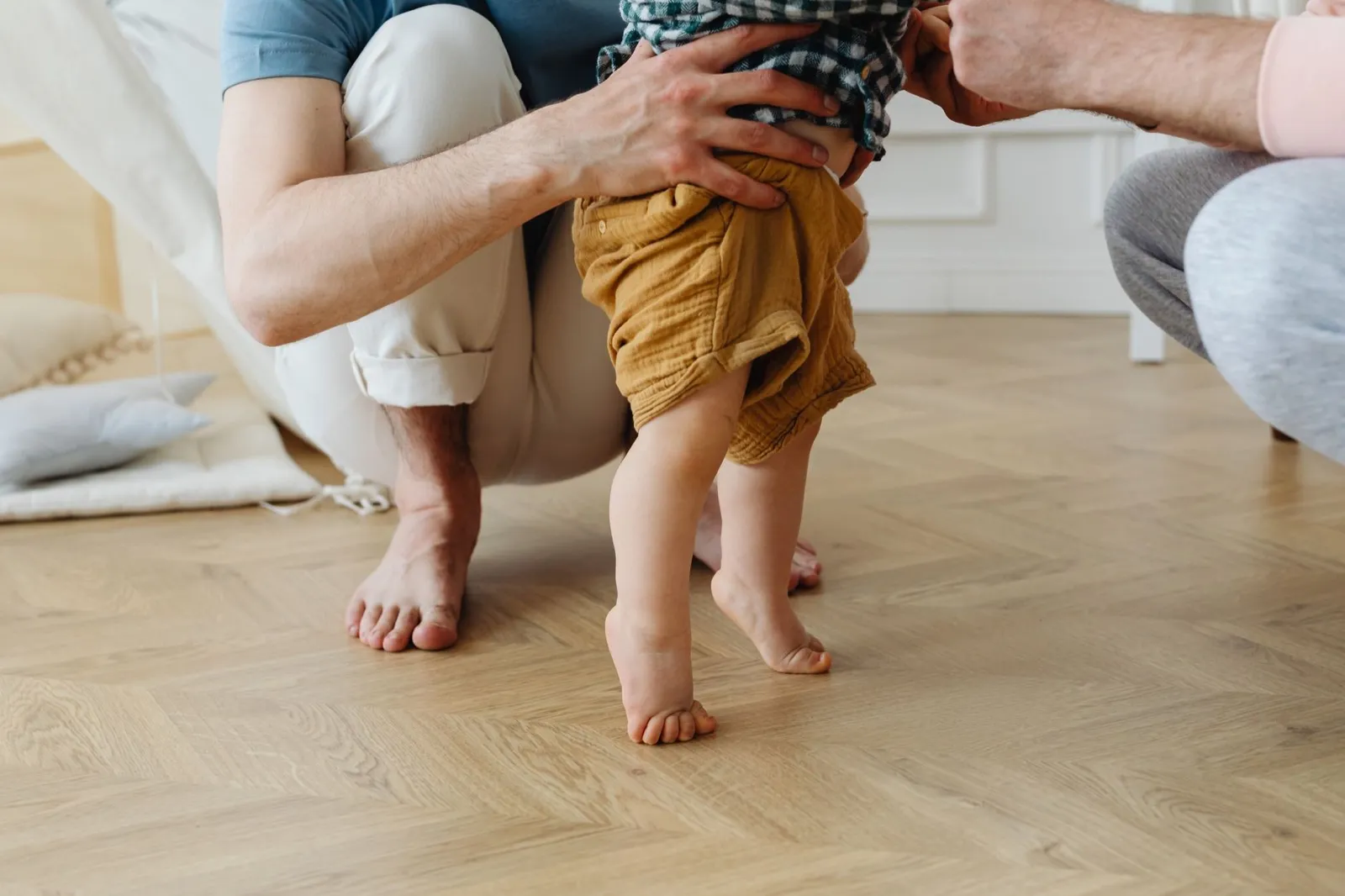
Image Credit: Pexels / https://kaboompics.com/
Many babies take their first independent steps sometime around their first birthday, but there is a wide range of typical development. NHS guidance says babies often start walking independently between about 12 and 15 months, although some begin earlier and others later.
Before independent walking, you may see your baby pulling themselves up, standing while holding onto furniture and moving sideways while supported, often called cruising.
There is no prize for walking early. Babies develop physical skills at different rates, and one child’s timeline is not a useful test for another. What matters more is the overall pattern of your baby’s movement and development.
What age do babies usually start walking?
Walking is a skill that develops over time rather than appearing suddenly at a particular age.
By 12 months, the US Centers for Disease Control and Prevention lists pulling up to stand and walking while holding onto furniture among the movement milestones most babies can achieve.
By 15 months, the CDC lists taking a few steps independently as a developmental milestone. By 18 months, walking without holding onto anyone or anything is included on its milestone checklist.
NHS children’s health guidance similarly describes babies as often beginning to walk independently between 12 and 15 months, while stressing that every child develops at their own pace.
These ages give you reference points. They should not become deadlines that create unnecessary worry if your baby’s development looks a little different.
What happens before a baby starts walking?
Walking independently requires balance, strength, coordination and confidence.
Long before those first unsupported steps, your baby is developing the physical skills that make walking possible.
You may see them:
- sitting independently
- changing position on the floor
- pulling themselves up using furniture
- standing while holding on
- lowering themselves from standing
- moving sideways while holding furniture
- briefly letting go while standing
- taking steps while supported
Not every baby follows exactly the same sequence.
Some babies crawl for months before walking. Others bottom shuffle or find another way to move. The NHS notes that not all babies crawl, so crawling itself is not a requirement before walking.
What is cruising?
Cruising is the term commonly used when a baby moves sideways while holding onto furniture for support.
It allows babies to practise shifting their weight from one foot to the other while still having something stable to hold.
NHS children’s physiotherapy guidance describes cruising along furniture as one of the skills that can develop before independent walking.
You may first notice your baby standing at the sofa and cautiously moving one foot sideways. With practice, they may become faster and more confident.
Once this starts, check that the furniture they use for support is stable and cannot easily tip or move.
Signs your baby may be getting ready to walk
There is no reliable way to predict the exact day your baby will take their first steps.
You may, however, notice growing confidence in standing and supported movement.
Signs can include:
- pulling up to stand
- standing while holding furniture
- cruising sideways
- shifting weight between the feet
- lowering themselves with increasing control
- standing briefly with less support
- reaching for something while standing
- taking supported steps
These are signs that your baby is practising the balance and coordination involved in upright movement.
They do not mean independent walking must follow within a particular number of days or weeks.
How to support your baby’s first steps
Babies learn physical skills through opportunities to move and practise.
NHS physical activity guidance recommends encouraging babies to be active throughout the day and providing safe opportunities for movement.
For a baby who is beginning to stand, ordinary play can offer plenty of practice. You might place an interesting toy on a stable low surface so they can play while standing or give them safe space to move between positions.
You can also:
- provide plenty of supervised floor play
- allow your baby to pull themselves up on stable furniture
- give them space to practise standing and moving
- place toys where they encourage safe reaching and movement
- stay nearby while they experiment with balance
- let them practise at their own pace
There is no need to repeatedly place your baby in a standing position if they cannot get there themselves or seem uncomfortable.
Your role is to provide safe opportunities rather than hurry the milestone.
Do babies need shoes when learning to walk?
Inside the home, babies do not usually need shoes simply because they are beginning to stand or walk.
The NHS advises allowing babies and toddlers to go barefoot where it is safe, as this can help the feet develop and allows them to feel the ground beneath them.
Shoes become useful for protecting the feet when walking outside.
When shoes are needed, NHS guidance recommends having your child’s feet measured by a qualified shoe fitter and choosing footwear that fits properly.
There is no need to buy walking shoes in advance just because your baby has started pulling themselves up.
Should you use a baby walker?
If by baby walker you mean a seated walker with a frame and wheels that allows a baby to move around, NHS guidance advises against using them.
The NHS states that baby walkers can cause accidents and recommends avoiding them. It also notes that baby walkers and bouncers encourage babies to stand on their tiptoes and may delay walking if used frequently.
This is different from allowing your baby to pull up and move around stable furniture under supervision.
If you are considering equipment designed to support walking and are unsure whether it is suitable, ask your health visitor or physiotherapist for advice.
What if my baby walks on their tiptoes?
Some children may walk on their toes occasionally while they are learning, but persistent toe walking is worth discussing with a healthcare professional if you are concerned.
The NHS advises speaking to a GP or health visitor about concerns regarding a child’s movement and development.
Try not to diagnose the reason yourself from videos or online descriptions. How a child stands and walks is best considered alongside their overall physical development.
Making your home safer for a new walker
A baby who is pulling up or beginning to walk can suddenly reach places that were previously inaccessible.
NHS baby safety guidance recommends securing furniture that could be climbed on or pulled over, keeping hazardous substances out of reach and using safety gates to prevent access to stairs.
Pay particular attention to unstable furniture. A baby may use almost anything at the right height as a handhold.
Hot drinks are another important hazard. The NHS warns that a hot drink can still scald a child 15 minutes after it has been made and advises keeping hot drinks well away from babies and young children.
As your baby becomes taller and more mobile, review your home regularly rather than assuming your earlier babyproofing still covers everything they can reach.
Do babies have to crawl before they walk?
No. Crawling is not a compulsory step before walking.
The NHS notes that some babies do not crawl and may instead bottom shuffle or use another method of getting around.
The CDC’s milestone checklists also do not include crawling as a required milestone before walking. By 12 months, the physical milestones focus on pulling to stand and walking while holding onto furniture.
Your baby’s route towards walking may therefore look different from another child’s.
If their overall movement is progressing and you have no concerns, a different sequence does not automatically mean something is wrong.
What if another baby is walking and mine is not?
Watching babies of similar ages reach visible milestones at different times can make comparison almost irresistible.
Try to remember that the difference between a baby walking at one age and another walking several months later can still fall within a broad developmental range.
The CDC lists a few independent steps as a 15-month milestone and independent walking without holding on as an 18-month milestone.
Your baby may also be concentrating on other skills while physical development progresses at its own pace.
Use milestone guidance to help you notice progress, not as a ranking system.
What if my baby is not walking yet?
If your baby has not started walking around their first birthday, that alone is not necessarily a cause for concern.
At 12 months, the CDC looks for pulling up to stand and walking while holding onto furniture rather than independent walking.
Independent steps are included at 15 months, and walking without support at 18 months.
If your child is approaching these ages without progressing towards walking, or if you are worried about how they move, speak to your health visitor or GP.
If your baby was born prematurely or has a condition that affects their development, follow the individual guidance provided by their healthcare team.
When to get professional advice
Speak to your health visitor, GP or another qualified healthcare professional if you are worried about your baby’s movement, standing or progress towards walking.
The CDC advises parents to act early if a child is not meeting one or more developmental milestones, has lost skills they previously had or if there are other developmental concerns.
Seek advice if your child loses a movement skill they could previously do, appears to use one side of their body very differently from the other, or if their movement simply does not seem right to you.
If your child is not taking a few steps independently by around 15 months or is not walking without holding on by around 18 months, these are also useful points to discuss their development with a healthcare professional, in line with CDC milestone guidance.
A milestone chart cannot assess an individual child. Your health visitor, GP or paediatric professional can look at your baby’s physical development as a whole and advise whether any further assessment is needed.
Related reading
Sources
- NHS: How to keep your baby or toddler active
- NHS: Physical activity guidelines for children under 5 years
- NHS: Baby and toddler safety
- NHS: Children’s feet and shoes
- Centers for Disease Control and Prevention: Milestones by 1 Year
- Centers for Disease Control and Prevention: Milestones by 15 Months
- Centers for Disease Control and Prevention: Milestones by 18 Months