How to Wash Baby Clothes: Detergent, Temperature and Sensitive Skin
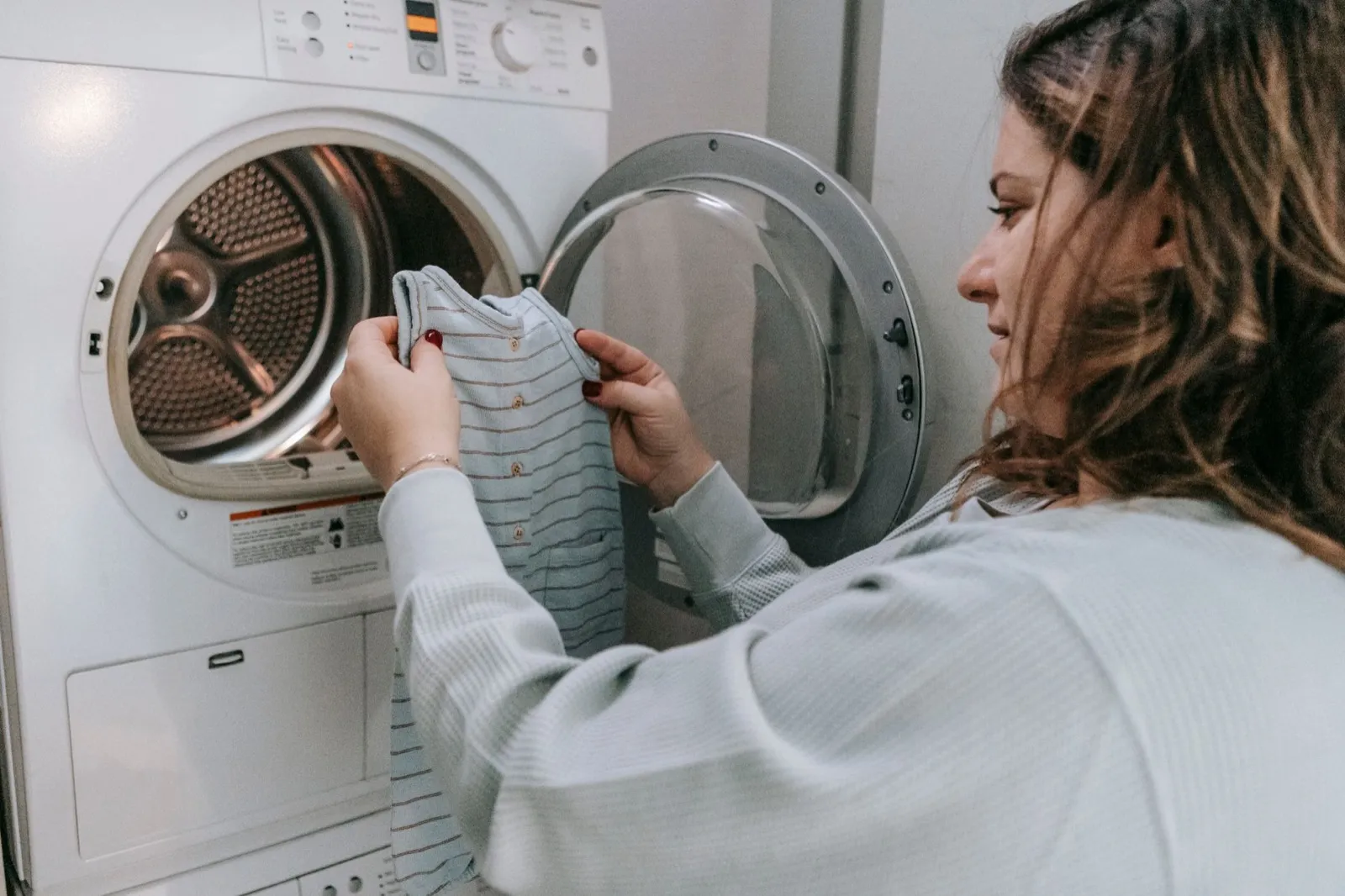
Image Credit: Pexels / Sarah Chai
Washing baby clothes does not need to involve a completely different laundry system. For most babies, you can wash everyday clothing in a washing machine with ordinary laundry detergent, following the garment’s care label and your detergent’s instructions.
You also do not automatically need a special “baby” detergent. The NHS says there is no evidence that biological washing powders containing enzymes, or fabric conditioners used on ordinary baby clothes, will irritate a baby’s skin.
If your baby has eczema, very dry skin or seems sensitive to a particular laundry product, however, a simpler routine may help. Fragrances and detergents can be irritants for some people with eczema, so individual skin needs matter more than buying products simply because they are marketed for babies.
Do you need to wash new baby clothes before use?
Many parents choose to wash new clothes before their baby wears them. It removes dust, loose fibres and residues that may have collected during manufacturing, packaging, storage or handling.
This is a sensible practical step, particularly for items that will sit directly against your baby’s skin.
You can wash:
- sleepsuits and bodysuits
- vests
- socks and hats
- muslins and bibs
- washable blankets
- cot sheets and other washable bedding
- towels and washcloths
Check individual care labels first, especially for delicate knitted clothes, wool, waterproof fabrics or items with special finishes.
There is no need to turn preparing baby clothes into an enormous pre-birth laundry project. Washing the first sizes and the items you expect to use soon is usually enough. Babies can grow out of clothes quickly, and you may never need every item you have bought.
What detergent should you use for baby clothes?
For a baby without known skin problems, you do not necessarily need a specialist detergent.
The NHS states that there is no evidence that washing powders containing enzymes, often called biological or bio detergents, irritate babies’ skin. It also says there is no evidence that fabric conditioners used on ordinary baby clothes will irritate a baby’s skin.
That means choosing between biological and non-biological detergent does not need to become another parenting rule.
A practical approach is to use a detergent that cleans effectively, follow the manufacturer’s dosing instructions and see how your baby’s skin responds.
Using more detergent than recommended will not necessarily make clothes cleaner. Correct dosing also makes it easier for the washing machine to rinse detergent from fabrics properly.
If you change products and notice that your baby’s skin seems irritated afterwards, stop using the suspected product and speak to a health professional if the reaction persists or worries you.
What if your baby has sensitive skin or eczema?
Laundry may need a little more thought if your baby has eczema or skin that reacts easily.
The NHS lists washing detergent as one of the irritants that can make atopic eczema worse in some people. NHS-linked Healthier Together guidance advises people with eczema to use non-biological washing powder, use an extra rinse where available and avoid fabric conditioner.
Fragrance can also be irritating for some sensitive skin.
If your baby has eczema or repeatedly reacts after wearing freshly washed clothes, you could try:
- choosing a fragrance-free or low-fragrance product
- using non-biological detergent
- using the correct amount of detergent rather than adding extra
- selecting an extra rinse cycle if your machine has one
- avoiding fabric conditioner if it seems to aggravate your baby’s skin
- changing one laundry product at a time so it is easier to identify a possible trigger
There is no single detergent guaranteed to suit every baby’s skin. A product that works perfectly for one family may not suit another.
If your baby’s eczema is being treated, follow the laundry and skincare advice given by their GP, health visitor, pharmacist, dermatologist or eczema team.
What temperature should you wash baby clothes at?
There is no single wash temperature that every item of baby clothing needs.
The safest starting point is the garment’s care label. Clothes are made from different fibres and may have different washing limits.
For ordinary lightly soiled clothes, use an appropriate machine programme and temperature for the fabric and detergent you are using.
Heavily soiled items may need different treatment, so check both the care label and washing machine guidance.
Cloth nappies are a separate case. NHS guidance says washable cloth nappies can be machine washed at 60°C and that nappies soiled with poo should be washed separately from other washing.
Do not assume that all baby clothes should therefore be washed at 60°C. A higher temperature can shrink or damage some fabrics and may be unnecessary for ordinary clothing.
Should you wash baby clothes separately?
You generally do not need to run a separate wash purely because clothes belong to your baby.
Everyday baby clothes can usually be washed with suitable family laundry if the items have compatible care instructions and nobody in the household has an infection or other reason for laundry to be handled differently.
There are situations where separating items makes practical sense.
Wash cloth nappies soiled with poo separately from other laundry, as advised by the NHS. You may also prefer to separate heavily soiled clothing, delicate items, strong colours or anything requiring a different wash programme.
If another member of the household has a contagious illness, follow any specific laundry advice given by the NHS or their healthcare team.
Do baby clothes need fabric conditioner?
Fabric conditioner is optional for ordinary baby clothes.
The NHS says there is no evidence that fabric conditioners will irritate babies’ skin in general. However, babies with eczema or known sensitivity may be different, and some NHS eczema guidance recommends avoiding fabric conditioner.
If your baby’s skin is comfortable with your usual laundry routine, you do not need to change products simply because someone says all babies require fragrance-free, non-biological laundry.
If irritation appears, simplifying the routine can make it easier to identify the cause.
There is one important exception: do not use fabric conditioner on washable cloth nappies. NHS guidance warns that it makes them less absorbent, which can contribute to nappy rash.
How to deal with milk, poo and food stains
Baby clothes can become stained remarkably quickly, but stains do not always mean an item is unhygienic after washing.
Deal with obvious mess as soon as reasonably possible. Remove solids carefully and follow the garment’s washing instructions.
For a stain remover or laundry treatment, check that the product is suitable for the fabric and use it according to the label. Rinse or wash the garment properly afterwards.
Avoid experimenting with mixtures of household cleaning chemicals. Products such as bleach and other cleaners can react dangerously when combined.
If an item remains stained but has been washed correctly, the remaining mark may simply be cosmetic. You do not necessarily need to keep rewashing it aggressively.
How to make baby laundry easier
Newborns can create a surprising amount of washing, and there is no prize for having every sleepsuit perfectly folded.
A simple system can save time:
- Keep a laundry basket somewhere convenient for dirty baby clothes.
- Check pockets, fasten hook-and-loop tabs and close zips where appropriate.
- Separate items that need special treatment.
- Follow garment care labels.
- Measure detergent according to its instructions.
- Choose an appropriate cycle and temperature.
- Dry clothes fully before storing them.
Having enough everyday basics can also take some pressure off. The NHS notes that babies grow quickly and only a relatively small selection of basic clothing is needed in the early weeks.
You may find it more useful to own a manageable number of clothes that wash easily than a large collection requiring different care.
What about hand-me-down baby clothes?
Second-hand and hand-me-down clothes can be a practical way to build your baby’s wardrobe.
Wash them before use and check their condition carefully. Look for loose buttons, broken fastenings, damaged seams, long loose threads or decorative pieces that are coming away.
Follow the care label if it is still readable.
If an older item has a strong fragrance from detergent or storage, washing it before use may help. For a baby with eczema or sensitive skin, an extra rinse can also be useful.
There is no need for clothing to look brand new to be useful. Clean, comfortable clothes in good condition are what matter.
When to get professional advice
If your baby develops persistent dry, itchy, cracked or inflamed skin, speak to your health visitor, GP or pharmacist. The NHS advises seeing a GP if you think your child has eczema.
Seek medical advice promptly if your baby’s skin becomes broken, very red or inflamed, blistered, crusty, weeping or otherwise appears infected.
If you suspect laundry detergent or another product is irritating your baby’s skin, stop using the suspected product and simplify the laundry routine while you seek advice. Do not assume every rash is caused by detergent, as babies can develop rashes for many different reasons.
For most families, washing baby clothes can stay straightforward. Follow care labels, use detergent correctly, choose a sensible wash cycle and adjust the routine if your baby’s skin shows that it needs something gentler.
Related reading
- Newborn Baby Hygiene Kit: What You Actually Need
- Baby Hygiene Checklist: What You Need for Everyday Care
- Baby Hygiene & Everyday Care